 Enterprise Open Source Laboratory System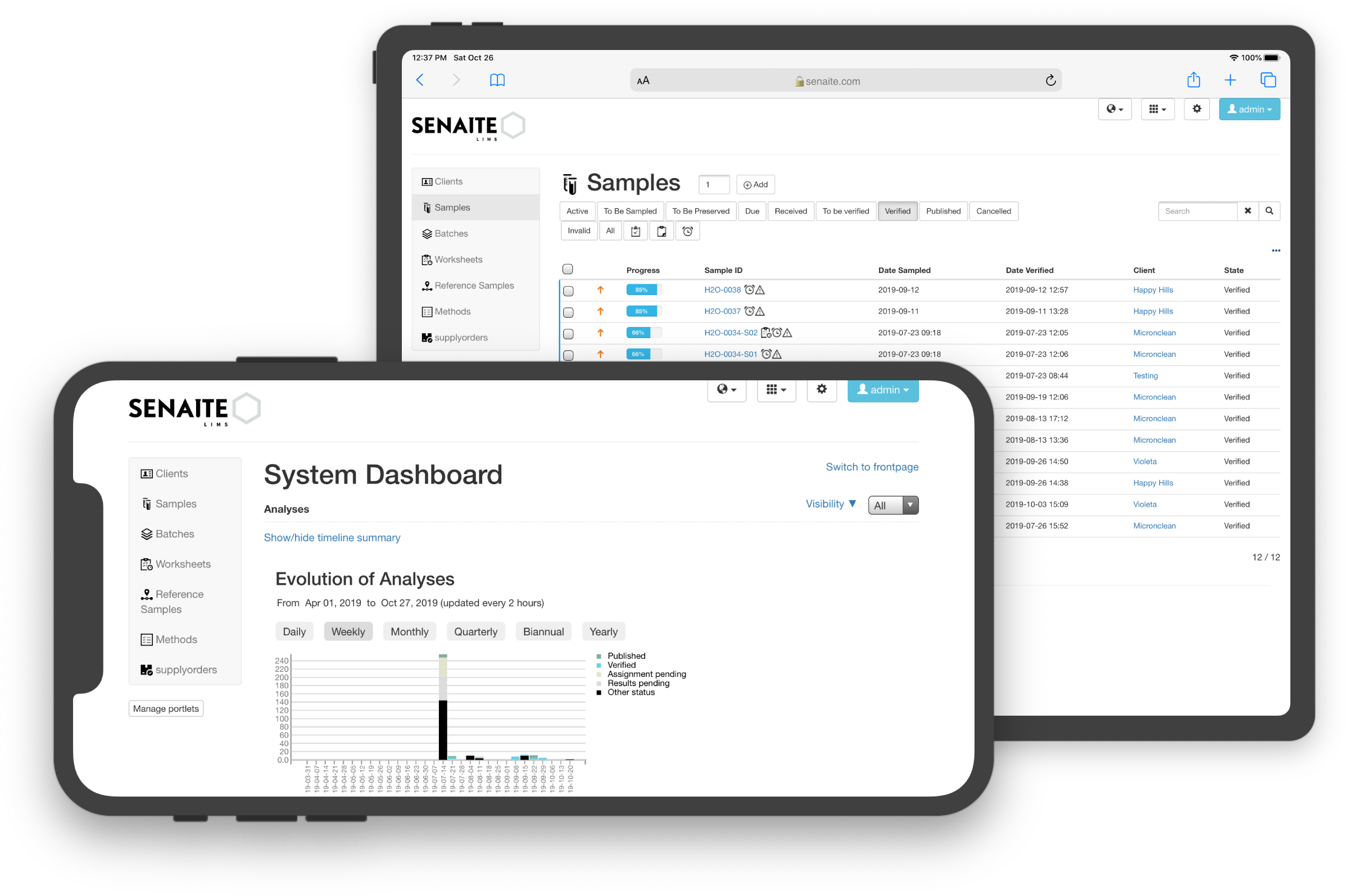
Performance
Process Automation
Process Automation
Amongst other functionalities, SENAITE comes with highly-customizable workflows to drive users through the analytical process, easy-to-use UI for data registration, automatic import of results, data validation and transition constraints.

Equipment Integration
Equipment Integration
SENAITE can be easily integrated with instruments by using off-the-shell interfaces for data import and export. Custom interfacing is supported too. Import instrument results and avoid human errors in the carrying over process.

Turnaround Time
Turnaround Time
Reduce the turnaround time on results reports delivery. Assign priorities to samples and due dates for tests, plan and assign the daily work by using worksheets and keep track of delayed tests immediately.
Control

Compliance
Compliance
SENAITE is ready for use in an ISO/IEC 17025 compliant environment, if setup and run properly in an appropriate infrastructure. Although SENAITE by itself can not be certified by its own, we can help review and validate your compliance.

Audit and Traceability
Audit and Traceability
SENAITE records and generates snapshots of your data on any modification, including the user name, IP address and datetime when the electronic record was changed. All changes in the system can be easily inspected, analysed and traced back.

Data Insights
Data Insights
SENAITE provides a powerful dashboard to visualize the performance of the lab on a daily, weekly, monthly, quarterly, biannually and yearly basis. Business Intelligence tools can be connected to SENAITE through the use of its JSON API.
Technology
Industrial Strength Security
Industrial Strength Security
SENAITE is based on the Content Management System Plone, that has the best security track record of any major CMS. Besides that, SENAITE comes with several mechanisms to prevent members or business associates making accidental or intentional changes that improperly alter or destroy electronic records.

Reliable Architecture
Reliable Architecture
SENAITE can be run on Linux servers together with high availability web servers, load balancers and proxy servers. It can be easily deployed in virtualized environments. Thanks to Plone CMS, SENAITE connects and plays well with your infrastructure and is adaptable to your business needs today and 10 years from now.
Centralized System
Centralized System
SENAITE works in the web browser, which improves the information flow and lowers the hardware expenses. This gives IT departments better control and reduces maintenance tasks, which leads to a reduction of costs, increase of productivity and helps to meet industry regulations, as they usually require varying degrees of IT system centralization.
Open Source

Lower Total Cost of Ownership (TCO)
Lower Total Cost of Ownership (TCO)
Using open source software yields a lower total cost of ownership when compared to closed source and proprietary alternatives. Adopting open source software generally has a lower up-front cost, and shifts the cost center from licensing (an operating expense) to customization and implementation (a capital expense).
Additional costs like training, maintenance, and support are sunk costs. You're going to be paying for both regardless of if the software is open or closed source, the cost often being baked into the license in the case of commercial, off-the-shelf software (COTS).
What makes open source unique is that you're not paying for the right to use the underlying intellectual property.
Source: Why Open Source by Ben Balter, Nov. 23, 2015
Reliability, Security, Performance
Reliability, Security, Performance
FLOSS has significant market share in many markets, is often the most reliable software, and in many cases has the best performance. FLOSS scales, both in problem size and project size. FLOSS software often has far better security, perhaps due to the possibility of worldwide review. Total cost of ownership for FLOSS is often far less than proprietary software, especially as the number of platforms increases.
These statements are not merely opinions; these effects can be shown quantitatively, using a wide variety of measures. This doesn’t even consider other issues that are hard to measure, such as freedom from control by a single source, freedom from licensing management (with its accompanying risk of audit and litigation), Organizations can transition to FLOSS in part or in stages, which for many is a far more practical transition approach.
Source: Why Open Source Software by David A. Wheeler, rev. Jul. 18, 2015
Trusted by